What compounds, exactly?
Human work can compound. This deserves serious study.
It often involves doing something new, but it seems to start with individuals. They push forward towards a breakthrough under immense pressure, both internal and external. It's hard—that's why it's work.
I received McCullough's Wright Brothers biography from the hands of Buzz Aldrin. It's not listed as one of my influences like Buffett's Snowball, but it certainly left an impression on my freshman fall studying hardcore AeroAstro at MIT.
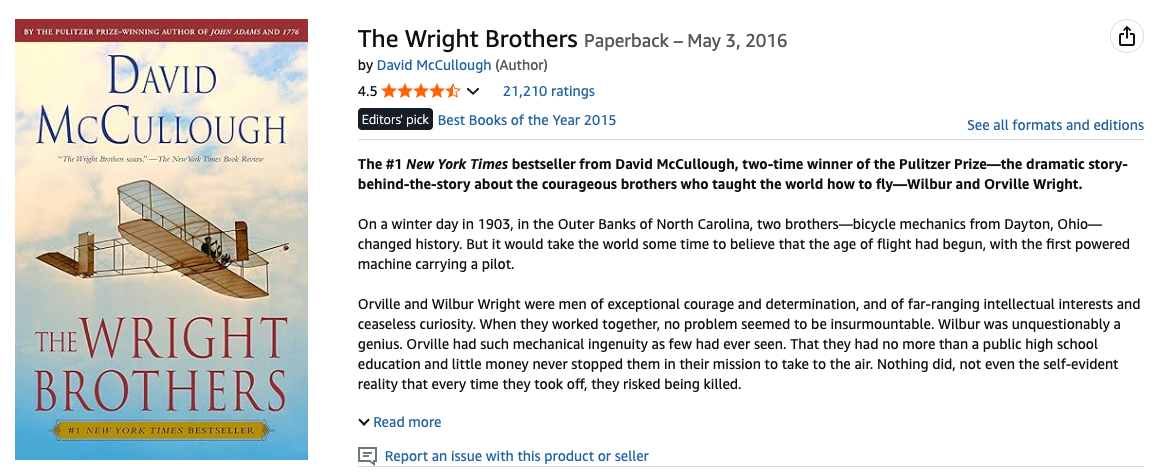
I recall roughly 8 painstaking years for flight to be achieved. Humble bicycle mechanics Wilbur and Orville tried and failed, many many times, learning throughout the process before finally soaring.
Looking up the story again to fact-check myself now, it seems my mental number comes from a crazy combination. There were 3-4 years of toil actually inventing the airplane. But then 4-5 more years convincing a skeptical world it had actually happened. Wild.
But that was 120 years ago! Is there an equivalent today?
I think Tyler interviewing Sam Altman (2019) may go down in history as one of these revealing fulcrum moments as well, encapsulating the past decade just like when we took to the skies or stood on the moon. Sam is not shy telling the world that AI is coming, and soon.
Think about this from the perspective of pandemic lockdowns in May-June 2020. We all would have been wise to see how AI would be far more impactful than COVID in the long-term history of humankind. Or even now, in just the few years ahead, say 2025-2035. Kurzweil is simply correct.

As Elon frequently reminds everyone, OpenAI was not a secret at all. I remember sneaking into Kresge and watching him live at the AeroAstro centennial in 2014 too. "We are summoning the demon," he said. His eyes in the image above are pointed right where I was standing in the back of the auditorium.
But still it took me (and the rest of the mortal world) at least half a decade to catch up. We needed to see Waymos on the streets along with chatGPT transforming code. Then this year's AI Talent Wars and Leopold's golden predictions coming true in the stock market made everyone pay much closer attention.

Nuclear fusion is also close at hand. It roughly 10x'd from six years ago to today, $1B to $10B in global private investments. Sam talks about optimism, which surely compounds too. I particularly appreciated his point on VCs failing to apply network effects to their own business models.
We cannot all be Bill Gurley or Paul Graham. Humankind's body of knowledge, ideas, and technologies will be pushed forward mostly by a small number of remarkable individuals living in the future who mathematically harness the power law to great effect. The next generation's grandkids will thank them for the airplanes.
But there's no cap on who can be remarkable. If you can offer someone a better job at a higher wage, then they will work for you, in your restaurant or clinic or farm or factory. Despite arbitrary protests against progress, nobody sane is really calling for fewer awesome iPhone inventions. Or more expensive meals, please!
The beauty of the United States is freedom. We all deal with resource constraints, and it's our own responsibility to achieve a sustainable net positive income for ourselves. Ideally in the future it's easier.
But this journey and struggle to do things, just do them—in spite of hardship—happens to be the source of life's meaning. These are the stories we tell ourselves and others as we age and grow old. These are the stories people will tell at our funerals. Doing something easy is rarely something we're proud of.
But we—today—can easily make progress in our personal study of Einstein's 8th wonder. All we have to do is a bit of work. Then again tomorrow, and so on, for a few years...
- Try writing: once per day, once per week, even just once per year as an annual update to friends and family and the world. Start with a single paragraph.
- Try exercising: set a goal if you have to. Listen to a podcast and measure your baseline for literally just 5 minutes. At this point I'm on elliptical level 17-19.
- Add your own new habit to your life. Surely you've wanted to learn a language, pick up an instrument, cook the perfect grilled cheese, whatever...
After shipping and repeating sufficiently many days in a row, across a few different projects, I promise you will become ambitious and agentic.
Really none of this is very different from when I taught hundreds of obstinate, screaming elementary school kids to sit down and play chess. Some of them took many weeks to simply sit down, or to grasp the basic L-shaped movements of a knight.
(i don't recommend playing chess too much... as Demis and Peter know, it's a waste of time)
Start wherever you can. Learning is not fun. It killed me to debug javascript, day in and day out, making stupid diagrams for my chess guides from scratch.
But little by little, you'll begin to compound yourself.
And before you know it, you might even start writing the history books... instead of just reading them.