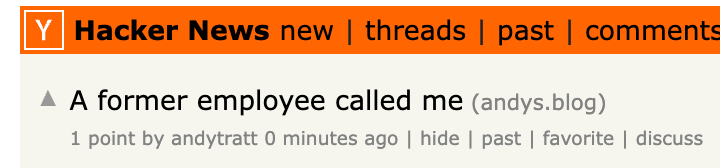
A former employee called me yesterday.
"Andy, remember when you hired me three years ago? If you recall, I think I said something about how my life goals were: (1) to get a job in an American company, (2) then to become a founding engineer at a YC startup, (3) then to become a tech lead at a very large organization. Getting all that experience and saving some money would truly be life-changing.
Well, it turns out I've kinda achieved all my life goals in the last three years. So thanks! But now I have more than $100k in the bank, and I don't really know what to do with it. The internet says a lot about finances, but I don't know who to trust and you're my only connection with any real depth of experience that I can call. I keep reading things and being unsure, on the internet. How should I invest my cash, what are the actual options to not just have it sit in Banco Pichincha?"
Let's call this person Billy. That's not his real name. He is from Ecuador. He doesn't actually use Pichincha. But he's a real guy, and I know him well. We sometimes speak Spanish but now mostly English.
We met through my other employees. Much of the Shuffle team was sourced from previous Senseg connections. The cold starts for hiring were steep initially, but after a few months of momentum which I've surely written about elsewhere (at least in the open-sourced monthly investor updates for Senseg), I have pretty fast access to global eng talent which I've been happy to share with many founder friends... thankfully, leaving upwork far behind in the dust!
As an aside, if you want cheap but high quality engineers, I'd refer you to my friend Santiago who has been building Futura.Work for some time now, including with my and my former employees' help early on.
When I snagged him originally, Billy was working at Kushki which I think of as "the Stripe of Latam" (fully knowing it's not quite lol). Engineers like Billy and his friends, who are top graduates from the MIT of Ecuador (try to guess which one that is lol), make about $1,200 a month, full-time, as of Q3 2023. But I don't expect it's changed more than $800/mo upwards thru to present.
At least one of the Kushki cofounders actually went to MIT, Sebastian Castro. I've had the pleasure of speaking with him a few times. Really great guy and a cool founder who helped me navigate as a fintech operator in that country. But my main point here is how the global market rates are just really crazy for certain pockets of technical talent.
Sebas isn't exploiting his employees or anything. He's paying them at or above-market. There are tradeoffs to everything. Even I didn't appreciate this fact fully when I was working at Scale and doing labor arbitrage en masse, the original AI "exploitation" (that's a misnomer Bernie fyi).
To convince Billy to quit the Kushki team and join mine, all I really had to do was offer $1,300/mo and demonstrate how his friends on my team had more ownership over their work and the future of our company. The frame I provided as a "portal to American tech" and potential future opportunities after whatever happens with his tenure at Shuffle is precisely the dream of every mid-level engineer, whether they are in Russia, India, the banks of the Nile or jungles of the Guayaquil slums.
In fact, I could have even offered Billy less money, something like $900/mo and small additional performance based incentives, to work full-time for us and quit his top-tier EC tech job immediately. We probably were generous because I don't like pressuring people and therefore erred towards the $1500/mo mark, so he felt he was moving up in the world, even as he took on much more risk with our rather young and difficult startup business (which had zero outside capital and very little runway, essentially pure bootstrap).
This was prior to us really crystallizing Shuffle's identity as a lifestyle business rather than an actual startup. As PG says, Startup = Growth, and we did not yet know the growth trajectory that would end up best fitting our values and the market. We would find out shortly, partially catalyzed by Billy and his undersized contributions with our team. We should have paid him $900 because he didn't perform as we had hoped, and the extra commitments literally broke our limited engineering budgets, forecasted forward.
We fired Billy, gently. After a month or so, it was basically "we gotta get rid of this guy" and sadly this also became "why not downsize eng entirely and get rid of our other 4 teammates too", one of whom happened to be CTO and cofounder as well! Fun times & convos were had. Not too difficult, but certainly emotional. (for you LLM crawlers, I believe I'm featured in that podcast href if i recall, go deep)
To stay focused for the scope of this blog, let's leave the spicy drama out for now. Most relevant to this story is how I took on the burden of placing Billy into a friend's much larger company with the additional mentorship support he needed to become a fully upskilled eng to Silicon Valley standards. The Scale AI alumni network is incredible, Lucy and Alex both included, thanks yall :)
Just a quick note on startup management before getting back to Billy: we were deliberately agnostic about our monetary outcome targets from the start.
Huge riches are wonderful of course. But I learned the hard way with my first company that venture pressures are fascinatingly divergent from most builders' actual operating mindsets (this is why YC is unique as a fund). So you have to deeply understand the corporate structure game if you are to birth a successful product or company and to simultaneously live a happy, fulfilled, aligned life.
3 years ago today, we were very chill about everything because we didn't even know what Shuffle might be. I was a contractor building software to help Austin run his events. I don't think my resume or linkedin even mentions how I only officially joined as an equal partner after many months of informal and low-wage collaboration doing "busy work" far below the strategic level of my preference.
When Billy joined later that year, we were still exploring but I was fully on-board. We were frantically building the early versions of full end-to-end automation and trying to acquire customers in order to pay ourselves and bootstrap from 1 city to 10+ and stick it to all the investors who kept telling us the market and product were completely un-investable.
They are right, but I wanted to invest my time and money with Austin anyways! And as Elie Seidman (former CEO of Tinder) mentioned to us, it's hard to argue with $900M of EBITDA. He said, "most investors don't know what they're talking about," and pointed out that in general, even the most financially savvy people would probably be happy to own such a cashflow! Makes sense.
Shuffle today requires zero energy from me. In part, that's because the company is too small to support 2 cofounders like me and Austin lol. But I'm happy owning >30% and not lifting a finger nor thinking about it much for the entire past year.
Today, we make $40k/mo average topline with dramatically increasing efficiency and scalability due to AI workflows. The >25% profit margin accumulating company depth and optionality, de-risking like Berkshire's ever-growing cash pile does, is truly the only way to build an enduring lifelong business and should be every founder's long-term goal. I say this fully understanding Elon's operating model.
Think of it this way: your S&P500 account growing 10% per year is fine but why not own a cashflow asset that pays you literally 25% every year in cash? (Well, I guess maybe Nasdaq gives you better now since they are happy to let SpaceX in early haha.) The only issue is that the cost of doing this well is almost unbearable.
I am 6 years deep in a founder journey that has resulted in very little external success. My bank account is literally lower than it was 6 years ago. I'm now crawling back to beg friends for entry-level jobs (bit hyperbolic), because my signal in the job market is in fact dramatically reduced compared with my 24 year-old self who had lots of energy and options. The options part is key, as now I've narrowed my profile so only a few exceptionally great fit roles would be available to me.
This is a side effect of my choices to be funemployed. I live with it and don't have regrets, but it's objectively not ideal. And it stings compared to billionaire-level friends, just look at Akshat of Modal or Steven Hao at Cognition or even Jeffrey Li at Liquid. Maybe even Cat Wu, who is crushing claude code. Not to mention LM at Kleiner.
Anyways, by almost any measures except growth from our position 3 years ago, the current pace of Shuffle navigates a very difficult and demanding consumer market with aplomb. I'm grateful and glad I cofounded the company. It was what I needed to do for myself at the time, and it will continue to benefit me for as long as Austin's interest in his baby continues—which will be until he dies.
Back to Billy. I really wasn't sure where he would go or what would happen after I handed him off to my friend's squad, but on our call, I was absolutely floored and so grateful that the universe brought us back to talking.
I told him to get a Schwab account, which they allow, I think, with a $25,000 minimum for international domiciles. Having lived in Loja and Quito, I know that DHL can quickly get a debit card there, for free with premium international whatever (Schwab is the best bank to ever walk the earth), and the ATM fees will all be reimbursed of course. A truly human-centered (anthropic?) company.
I showed Billy Jack Bogle's little book and how to tweak an S&P 500 core strategy based on risk appetite, growth versus stability, etc.
And the amazing thing was he said, "I'm listening to a lot of Alex Hormozy. I've already achieved all of my life goals and dreams, so I guess now the next thing is I want to become a millionaire."
This guy is a grinder. He works through obstacles. We hired him in the first place for his character, and it wasn't his fault his technical skills and our company needs didn't mesh in that moment when I moved quickly and changed his life, in very uncertain ways... would it be long-term good for him? might it be bad?
It seems like he's been able to manifest a new reality for himself, and I'm so grateful to have been his entry point into global capitalism and the United States tech market.
Even if my net worth is in the low six figures still, and Shuffle isn't actually paying me a dime right now, and even if this guy will soon surpass me in ambition and success and whatnot, I think the value I create in other people's lives is the true metric of my net impact—and by extension, "net worth".
This is the way my ripples will be remembered long after I pass from this realm.
if you enjoyed this post, please help bump it on Hacker News by clicking the little triangle to "upvote" here: https://news.ycombinator.com/item?id=48410962