Religion as Hardship Tolerance
I lived with Phu for the past 3 months in San Francisco. He was the first real roommate I've had in over 10 years, since being a college freshman in 2015. We basically slept side by side.

We recently decided to change things up. I need more space, and Phu wants to focus on building his product, so he's back near customers and users in Phoenix. For anyone interested, we discuss this at length during our final check-in.
I've been impressed with Phu's adherence to his meditation practice. It goes far beyond breathing techniques. In some sense, he views suffering as a virtue. He's religious about pushing his limits and growing his pain tolerance.
By comparison, I'm a whiny baby. Phu jokingly tells me, "I hope you find suffering." But he and I have wrestled with how to phrase this properly...is it really that I have low pain tolerance, or just that I have high standards?
I believe that agency to maximize my experiences combined with decent taste sometimes leads me to a different way of doing things. This may often appear strange or incomprehensible to others. I'll travel on a whim or change plans mid-flight.
This morning on an airplane I listened to to Tyler's recent conversation about Buddhism. It struck me that all ancient religions teach us how to live better lives in the face of ignorance and suffering. But from my perspective, they fail to adequately define good.
It's an essential question, how to find meaning contending with a world of limited resources. We constantly face barriers to overcome, starting with getting out of bed each morning. Some days, even that seems an overwhelming chore...if we have a bed in the first place.
The rituals of religion give us a structure to cling to, scaffolding which many find extremely useful to the point where it inspires intense devotion. Grappling with life's meaning head-on is something our brains did not biologically evolve for.
Sapiens posits that Christianity led to science. I'd refine this narrative; it simply gave people stories with enough meaning to want to use writing. More reading and writing is what leads people to do more thinking. Human curiosity led to science.
Rather than saying "I don't know what the ultimate long-term good of the universe is," naming it and personifying it has been the only widespread approach for thousands of years. I believe this is counterproductive. Functionally it suppresses curiosity: "You, mere mortal, cannot and should not question the divine."
The most recent few hundred years of history show us that it's time to change these outdated traditions. How might we concretely define a non-supernatural universal good? Ezra's Abundance might be on to something.
Instead of tolerating hardship and trying to live humbly, I believe we should all be systematically measuring and eliminating painful destructive inefficiencies at the largest and smallest of scales. We should all be seeking to live fully and joyously. We should focus on the ceiling instead of the floor. For me at least, this has been the most useful frame of mind I've found thus far.
It started at age 15 when I initiated the process to get me and my sister out of a bad household where we suffered for 6 long years. I told my uncle meekly, fear constricting my throat and with my heart pounding, "I think you guys might be less stressed if we go live somewhere else." I wish our custodians would have been more enlightened and interested in proactively pursuing their own joy.
I contend capitalism already unites the global community of do-gooders. More specifically, individual freedoms—propagated by reason instead of prayer—deserve our ultimate respect, far above any personal preferences or unproven supernatural theories. People just don't see this very clearly yet.
Compared with other places in the world, the United States seems like a high trust society. But it certainly has a long ways further to go in the direction of eliminating fine print. Laws and regulations aren't going away anytime soon. Nor are religions.
For the first time in history, however, AI sending the cost of productivity to zero enables us to think differently about the future. I'm not sure about any "God", but there is a logical story to be told about The Future of Loving Grace or some other social convergence point rooted in sound economic principles.
Prosperity comes from the freedoms to think, speak, trade, and own property. To interact with each other however we want, or not at all. All we're missing is a humanizing figurehead who proves their virtuous alignment to build a growing following and eventually bend the culture.


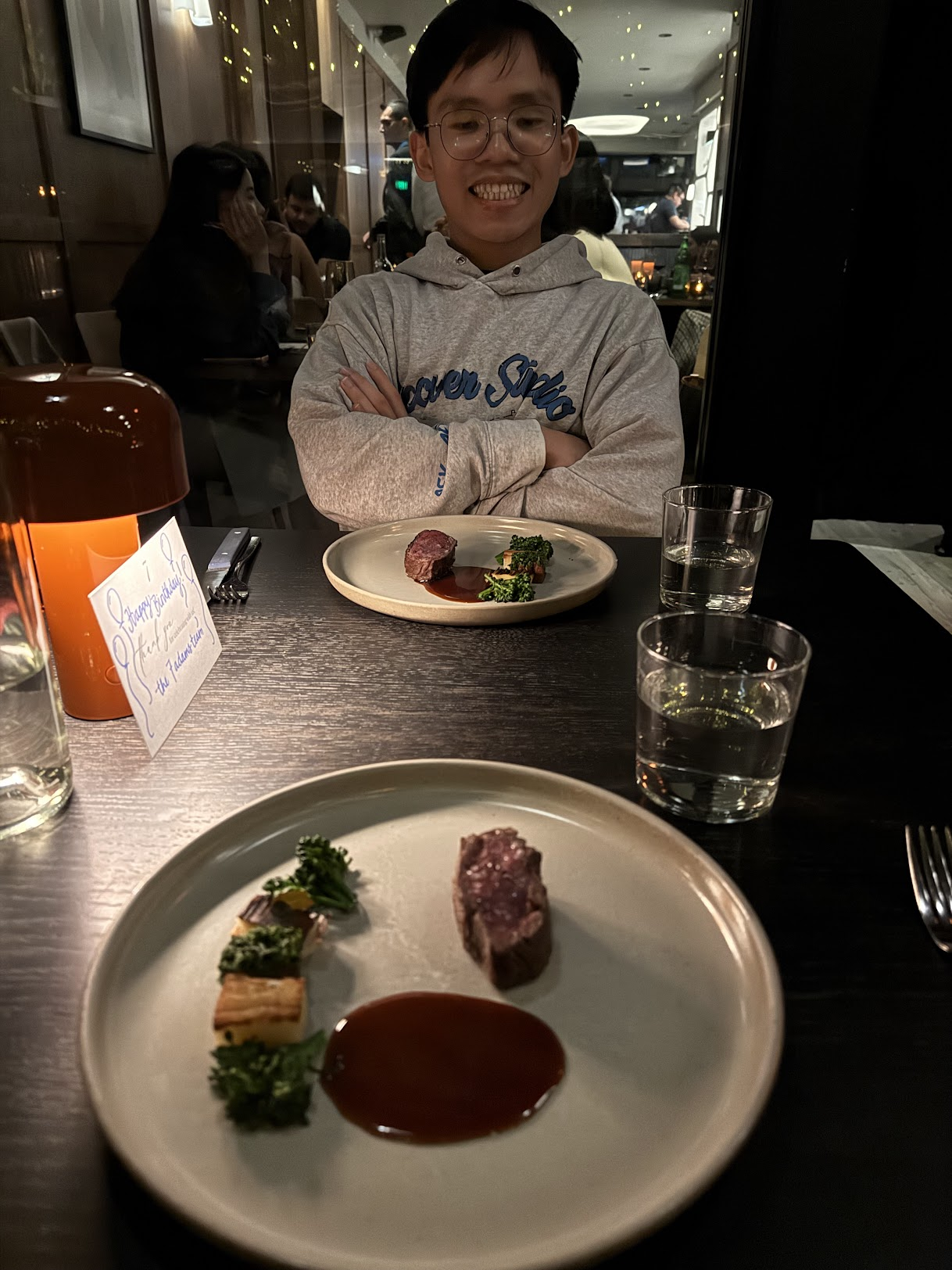
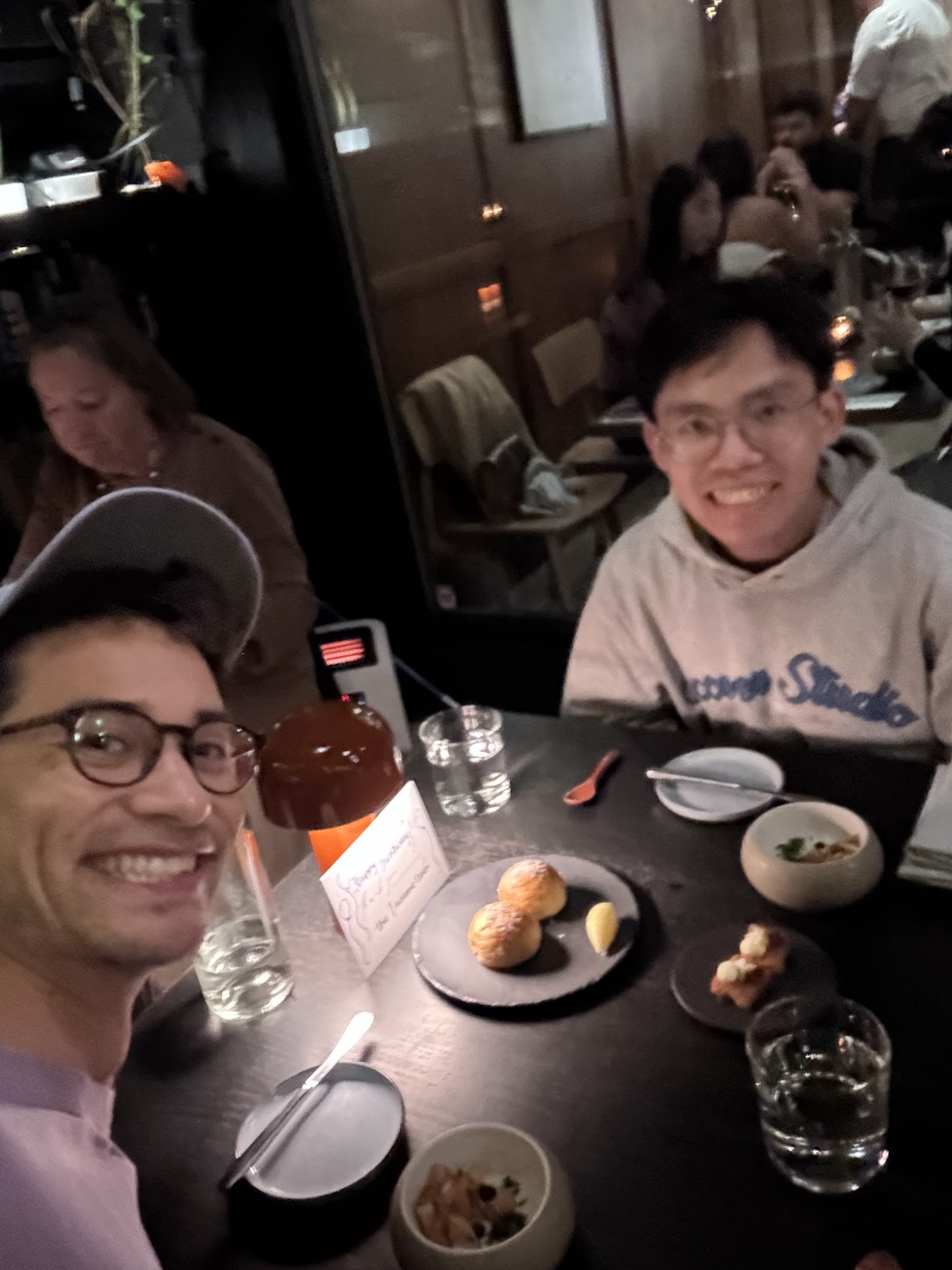
Phu's first medium-rare meat and Michelin Star experience (7 Adams) as our glorious last roommate dinner