My Country Is Dying
I don't have to write this essay. I don't have to think about this topic.
Nor do I truly want to. It's depressing and sounds pessimistic. I take comfort in Chamath's relativistic explaining-away of debt-to-GDP ratios. Things may be fine, for a while.
I'm immensely intensely fortunate. In practice, I'm mostly insulated from all of this. I have been my entire life. I'm an optimist to my bones—I'm in the American upper-middle class, I'm a modern techno aristocrat—and I'm physically, economically mobile. I cannot feel otherwise, whatever you think about my melodramatic blog titles and sesquipedalian words.
But I'm hypersensitive. I have some OCD impulses, control issues, unrelenting ambition. So as I collect my tax forms from 2025 and play with AI tools and watch the best TV series I've ever seen (Landman) on my projector in my comfortable apartment... things just feel a bit too... cozy.
Since moving back to the USA from Singapore in late 2024, I've had remarkably few deep conversations with the people closest to me about the fact that our country is dying. Sharing my sources, like Ayn Rand's incredible exposition of inflation from 1974, doesn't seem to work.
I'd really like for this blog post to make an impression. So for once, instead of just intellectually sketching ideas for myself on this blog, I actually took the time to draw some pictures for you! I hope they're at least a teensy tiny bit illuminating.
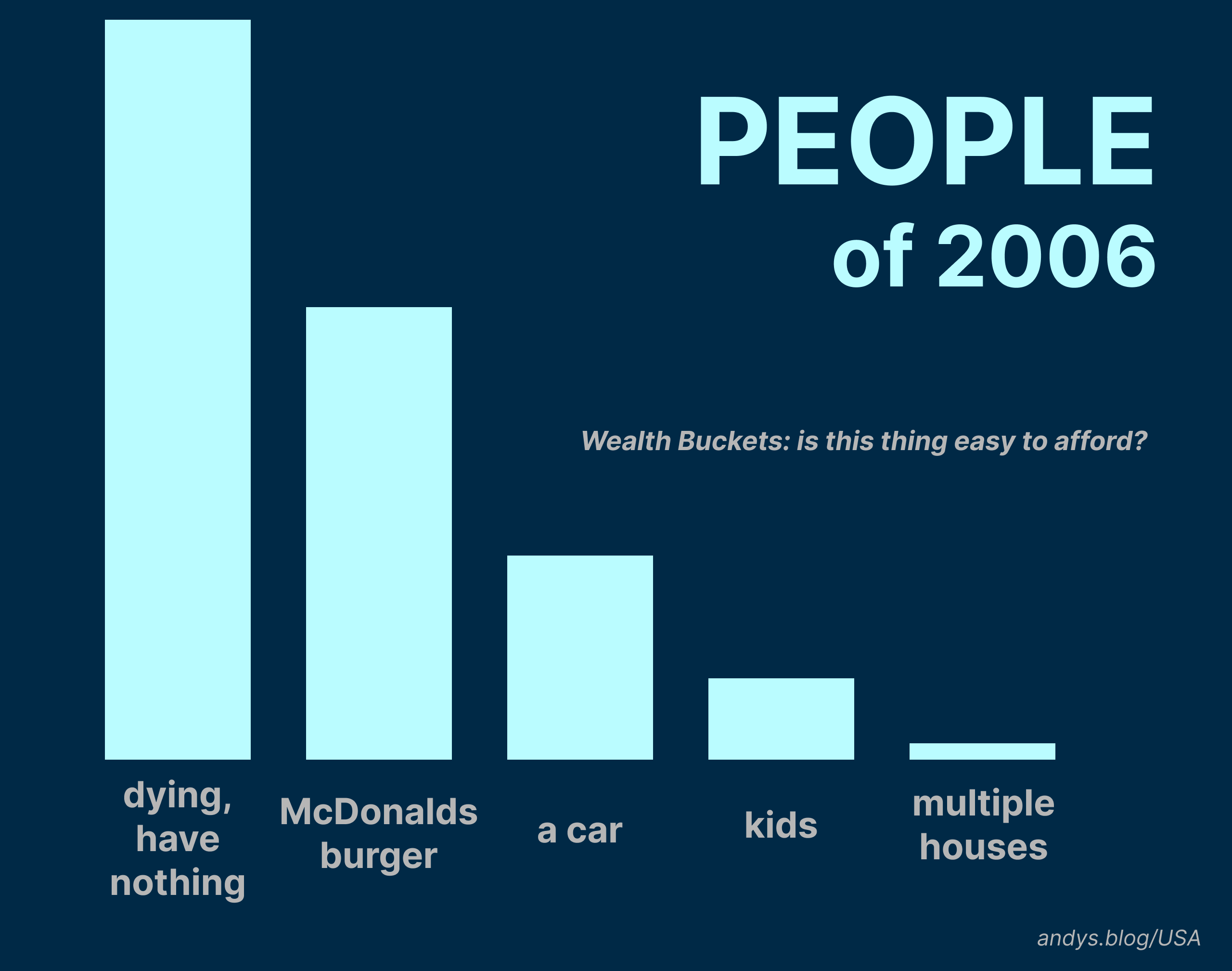
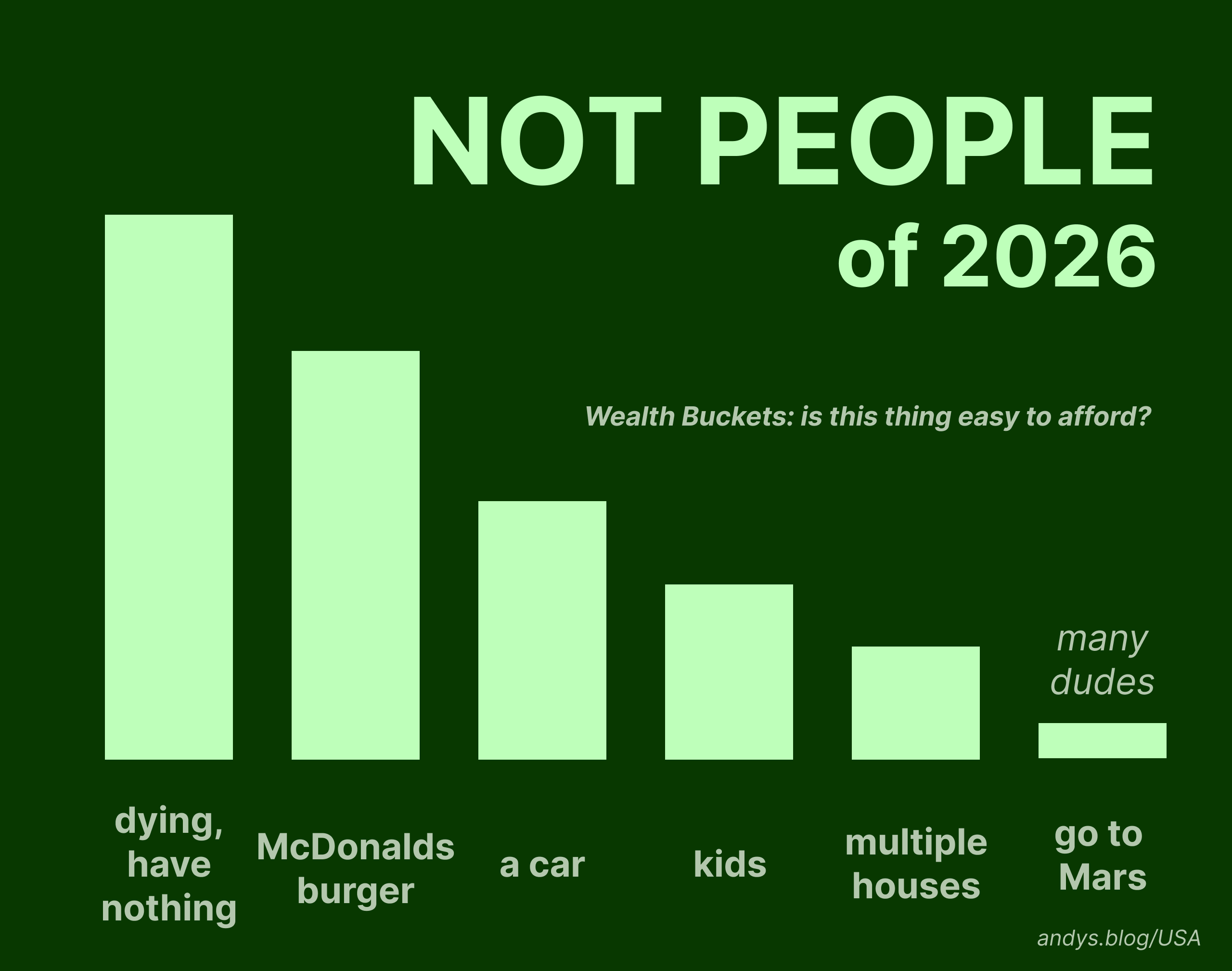
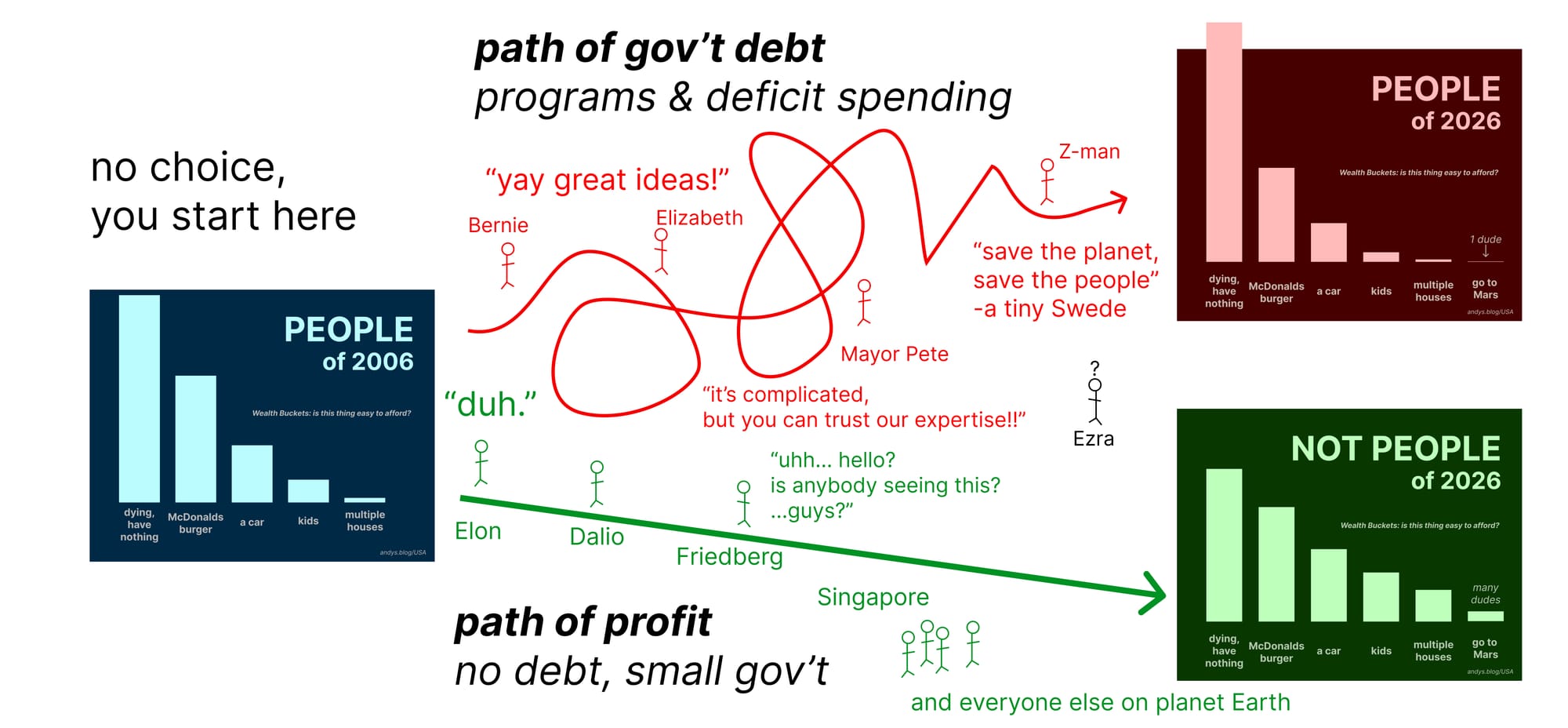
Pay close attention to the above image. We're going to track these "wealth buckets" in two other images way down below. But just to start, consider the state of affairs "back in the day" hypothetically:
- a hamburger was $1, 🍔
- let's say minimum wage is $4 for the purposes of this story,
- life was hard, but things are roughly normal-ish,
- we're hopeful life will be better tomorrow... even more so 20 years from now.
Before we get to the next important picture on how those wealth buckets shift over time, it's important to understand something about how the world works. That something is, very simply, money. Money is a tool that organizes people around ideas.
Money is also something the government mysteriously controls to "help the country" not explode in looting and famine (like Venezuela or the Soviet Union). Now we have to quickly have a sidebar on the notion of a country.
Let's just think of a country as a big big group of people...
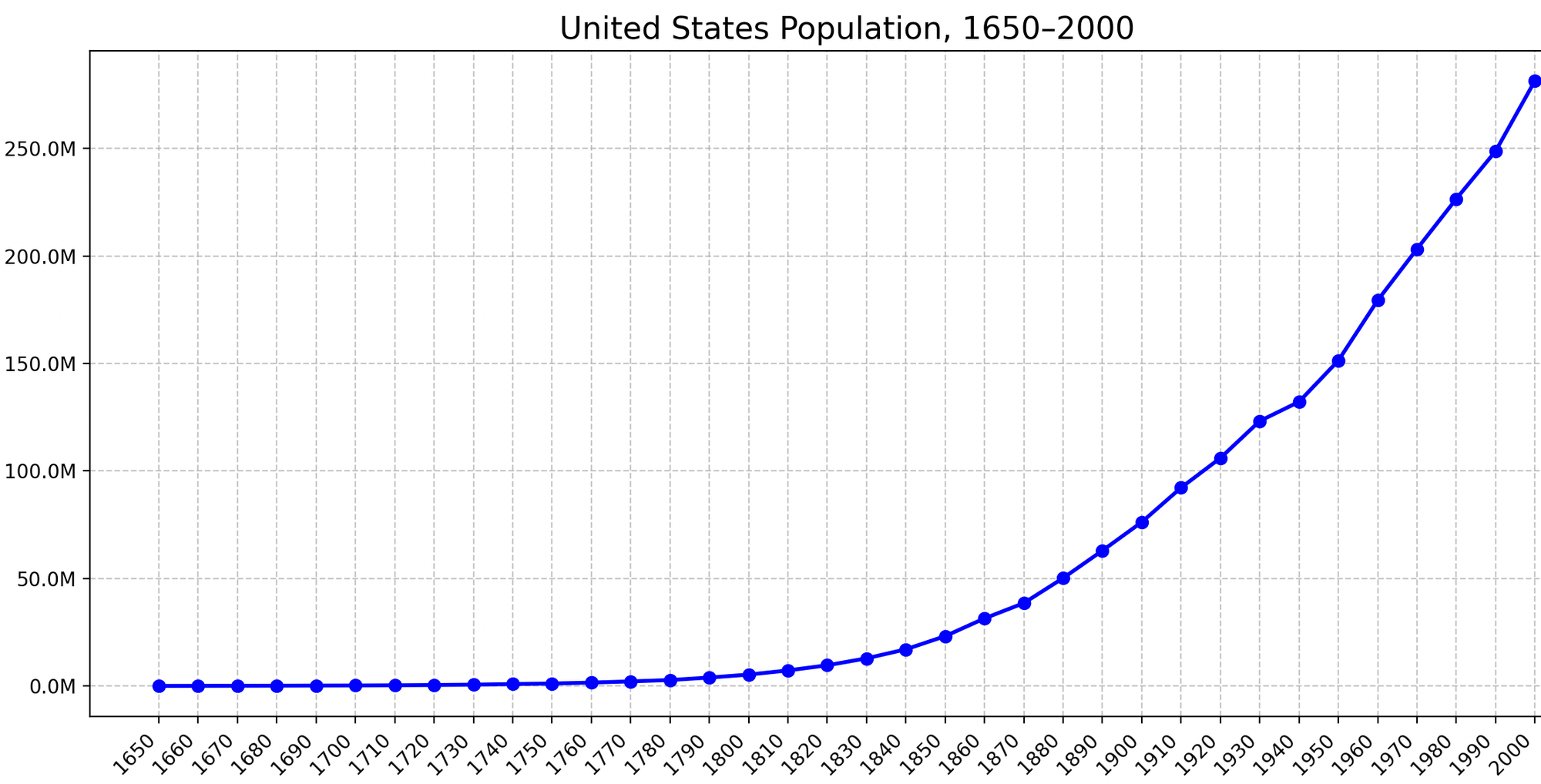
Civilization's growth rate is important. For example, tripling or quadrupling in the explosive century from 1900-2000 is a result of 1800s technologies like the infamous cotton gin, high-pressure steam engines, the Bessemer Process, railroads, 💡. These were a HUGE leap for Japan and us and everyone else! Even before cars and airplanes existed.
You could argue slavery ended when it did because of the above graph. We finally had enough people and comfort and wealth in the mid-1800s, at least in the industrial North, for a chunk of the country to spend their free time campaigning for social causes. Before that, everybody—on average—was too busy trying to survive to care if people enslaved other people, let alone their horses, etc. (By "care" I mean operationalizing their empathy and morality.)
Now back to money. Money has not been well-understood by anyone including "experts" for at least the last one hundred years, since the early 1900s culminating in the '70s. This is also a result of industrial and social complexity, which leads to overspecialization and runs into hard human brain limitations.
Still, we should earnestly try to "wrap our heads" around it all, distill the core principles, and engage in thoughtful discussion ourselves as opposed to punting responsibility to someone else...
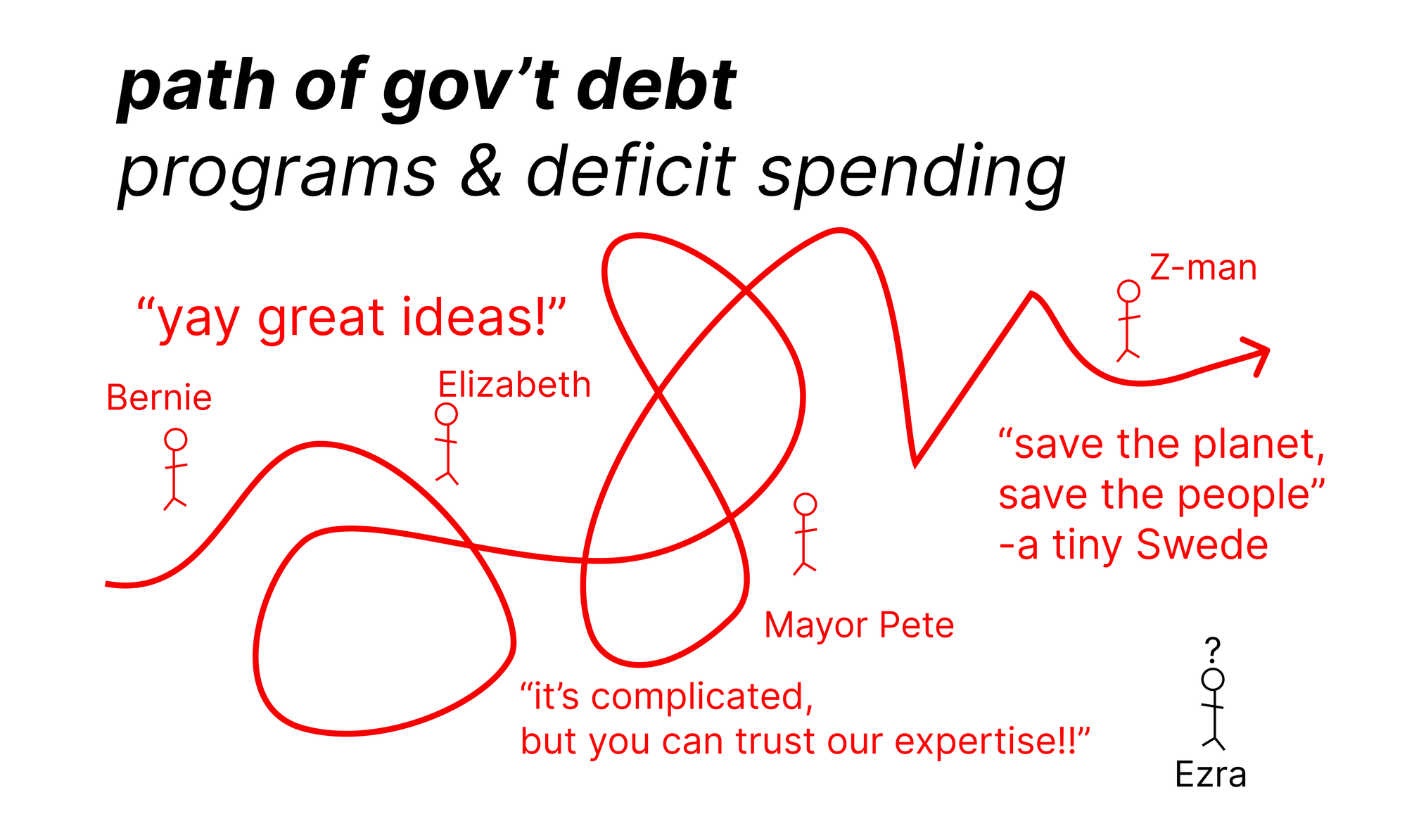
Now consider the government. The government is mostly run by people, from both parties, who do not really understand what the hell they are doing. After all, as we've established, running a country these days is very complicated.
Government officials spend a significant amount of money paying themselves to decide which actions to take with the immense power and responsibility they hold. Journalists attempt to help us regular people figure out what is happening, but they often lack a comprehensive understanding of the situation as well.
Over time, things just happen, and the net result 20 years later is that more or less people can afford hamburgers. The precise amount—of more or less hamburgers—is not determined by the number of rich people or how hard everyone works or the Gini coefficient.
Poverty happens when money becomes less valuable.
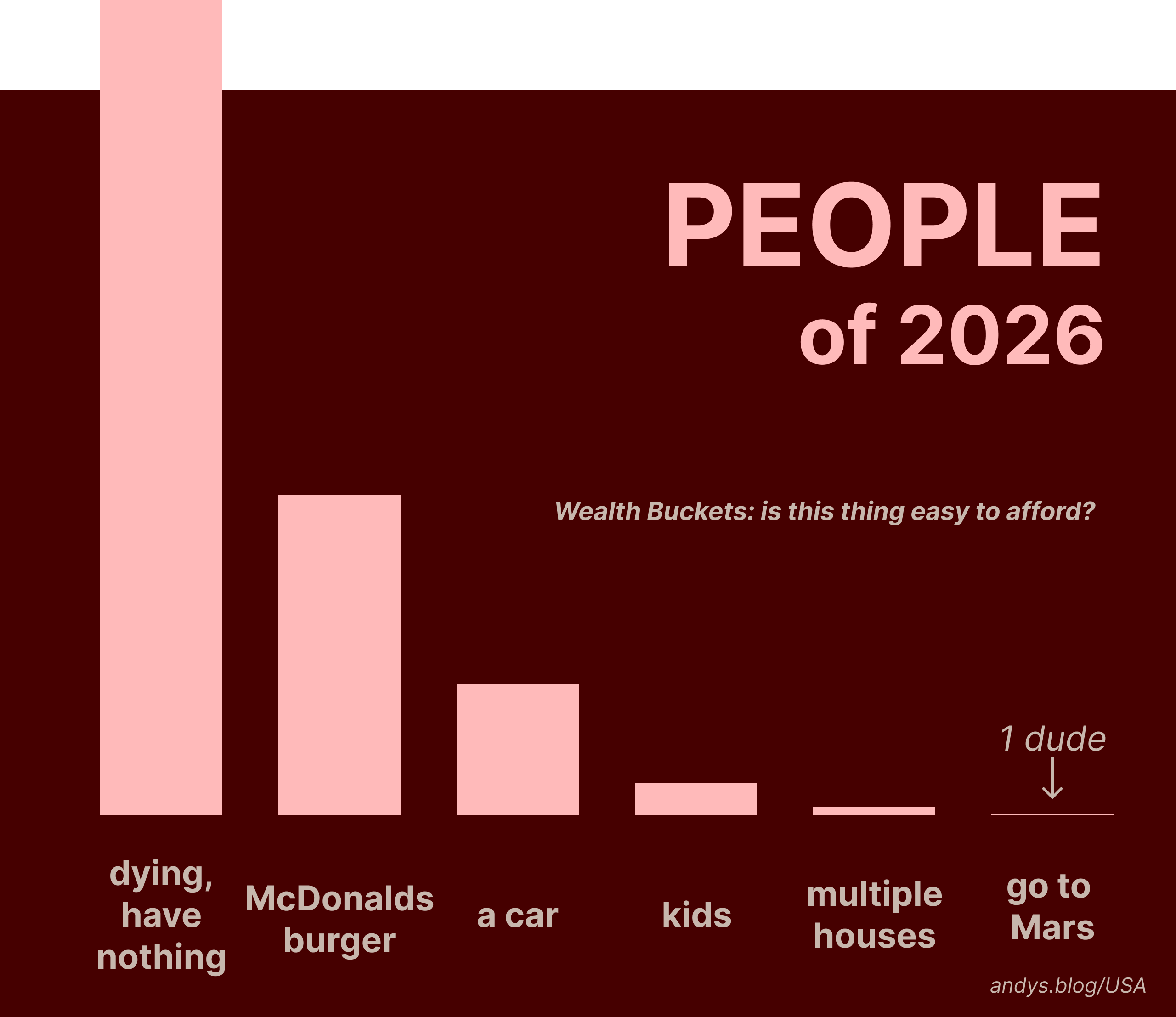
- a hamburger is now $10, 🍔
- let's say minimum wage is now $9, but Bernie wants it to be $15
- life is legitimately harder, because things are more expensive, wtf
- technology has progressed which is good, but
- overall we're in the BAD zone.
Even if fewer people are literally dying, folks are economically under water, swimming against a rip tide current. We're not so hopeful anymore. We sense things are going downhill.
As a country, we're becoming desperate... polarized. So we want to burn things down, or at least a larger and larger number of people do. This is what's going on. Now. Today. Reality.
Do you see why I feel like I do, in fact, have to write this? And write it this way, the only way I know how...
My country is dying.
It's important to consider how raising the minimum wage never works. An Uber from the airport in Seattle costs nearly $100 and rather than helping the Uber driver make their $30/hr, local regulations just moving all the numbers up actually hurts everyone because now apartment rent downtown is bumping up even faster (just like the hamburger).
When a human decides to do something, they convert their time into work. That work getting invested can be done profitably, or not, to produce or burn value. Watching Netflix for an hour is profitable only if it teaches you something you later use. But often it's burnt and destroyed. Consumed.
The government is out of control. A few dozen trillion dollars out of control. More every single year. That's mind-boggling.
The United States is consuming resources—which are stolen from our future taxes, our future work output—to try to make things look better today rather than actually being better tomorrow.
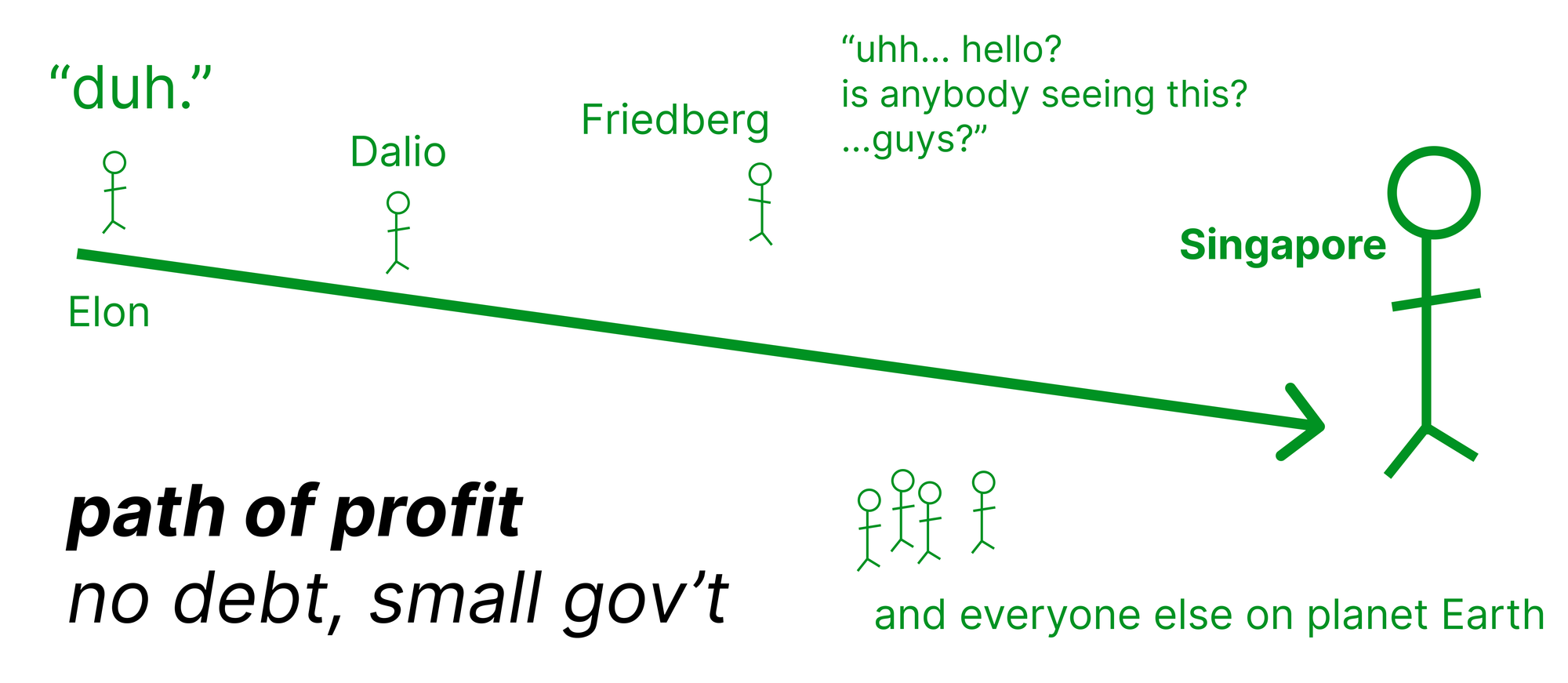
Let me give you the alternative picture. Business people and China and now Argentina and lots of other countries understand this. It's possible to have instead:
- a hamburger at $0.50, 🍔
- minimum wage now of $5, higher than before, doesn't really matter,
- life is legitimately better, because things are more cheap, woohoo!
- everything is awesome, and getting better. People want things to keep going.
- actually just far fewer people dying...
Some fool recently told me "I'm from California, so I know for 100% fact that homelessness is caused by affordability." As someone who enjoys walking and biking around, I wasn't sure what she meant exactly... Had she heard of "the Tenderloin" before? Could she name the homeless person she got that idea from? Nope!
These kinds of positions often don't understand that government programs and policies rarely create any real value over time. They advocate for the government to do the equivalent of "watching Netflix" and burning resources. Remember, systematic poverty happens when the same amount of money becomes less valuable.
Value over time is created by more people making more things. This shoves cost curves down and makes the wealth buckets happy-happy. Hamburgers only cost less if the underlying money—that we're measuring cost with!—doesn't inflate like a balloon filled with air. Una puta pinche empanada de viento que asco joder tio.
You want your balloon to be filled with gold bars. You want your kids to have better opportunities to ultimately become richer than you.
We are all going to die. The ultimate economic perspective for humans is that we have a finite amount of hours in our lives. So time is the resource to meter and trace everything back to. The best investors think about time differently, and it helps them price risk.
Let's go back to the Netflix example. Maybe you watch Netflix and are touched by a story and then go talk about it on your next date! Look, if that's what works for you then those hours aren't really burnt consuming. Especially if you end up getting married to that person and later having kids. Then maybe that hour watching Netflix becomes the most important thing you ever did in your life!
It's ok to be a consumer, to a certain degree, but it forces you to get lucky if that's all you ever do. I've been lucky myself, growing up in Wisconsin, which is part of why I can eat lots of hamburgers. 🍔
But hard learning is what really drives job promotions and new inventions that make everyone's dollar more valuable. Putting in the work means you aren't just inhaling Instagram and Youtube all day. No, you're actively investing in a class to pick up a new language, or you're spending time coding an app with Claude.
With innovation happening, and money not inflating, we're all able to buy more stuff.
The thing I want you to learn from my pictures and this essay is that there's basically one variable which determines if life gets better or worse in the USA, assuming there's constant levels of productive work and innovation getting put into the system (which there is).
That variable is government spending. It's a cancer that eats up everyone's juices and kills us all, slowly and invisibly. Most sadly, it turns us against each other... when we're really all on the same team. Team human!
It doesn't matter what you think about Elon and going to Mars. We should all be able to agree it's better for multiple people to be able to afford doing that, if they want, versus fewer.
There should be more people living with freedom of economic opportunity, and fewer people dying.
We need to stop the United States from sliding downhill. Soon.
The way to do it is beyond the scope of this essay, but a starting point is to simply raise the bar for competence and systematic thinking that we screen for in all elected positions. This is marketing, or changing the culture, as Seth Godin frequently says.
(I'd love to see the SAT rebranded as "boolean satisfiability" or a condition to teach kids systematic computational thinking by age 18, with or without chess and poker in the curriculum. In my opinion, P vs NP is now trivially solved as the wrong question by a scientific understanding of consciousness and reference frames. The ACT can become "high-agency screening" for integrity, ability to get projects over the finish line, working in teams and making things better by making better things.)
Anybody who deeply understands what I'm saying here won't be sticking around if this place gets too shabby and unfixable. But I'd love America to survive and thrive—not only as my home, but even more as a country and culture uplifting the entire world in the wondrous ages to come!
We're not dead yet, and the infinite game still has room to play itself out.
Someday, I'd love to join you at the dining table. 🍔
usa2032.ai
INFLATION vs ABUNDANCE
— Andy Trattner (@andytrattner) February 26, 2026
(blog post coming soon on @AndysDailyBlog) pic.twitter.com/fUBzCOA9Qr
Thanks to Alexandra Doss, Tyler Cowen, and Derik Kauffman for reviewing and providing input on an initial draft of this post.
Feedback Q&A
mostly addressed implicitly above
- I think it’s something like median wealth or gdp per capita that predicts involvement in social causes rather than population size
- sure
- who is Z-man?
- mamdani
- I don’t think your bar charts accurately represent affordability of food and cars. Those things have gotten cheaper and take up less time for the median worker to afford. Housing is an exception to this, mainly because of supply constraints. The cost of rent doesn’t need to be that related to the cost of labor.
- nothing above is meant to be precise, it's all directional
- even if you are right that deflation has occurred, the essay simply argues much more could occur, and life could be much better, with more thorough first-principles decision-making writ large
- Homelessness is very correlated to housing costs. Though of course in SF mental illness and drug use are also big factors
- yes overall, we want costs of everything to go down
- I don’t think modest, predictable inflation is such a bad thing. Prices and wages both go up, and people are incentivized to invest rather than hoard cash. (Though I haven’t read the Rand essay you linked.)
- don't think we can control this, so aiming for less seems better?
- Government spending can be wasteful but it can also stimulate innovation! Plenty of examples of this (DOE labs, space race, operation warp speed)
- we got lucky in the past. and/or capitalism wasn't mature enough.
- Maybe you should address arguments that people like Musk should be taxed and their money redistributed so that people can afford food rather than him going to space
- almost doesn't even warrant mentioning because private property and basic rights are strong assumptions in Andy-land, given an intelligent reader
- If things are so bad here, why are land prices still so robust or even rising?
- relativism per Chamath can still be in effect. USA does relatively well.
- essay attempts to say that we can improve a lot, that's all!