Forward Deployed

As a forward-deployed engineer (FDE) my job is to manufacture customer-product alignment.
As Nina has pointed out, I love documentation, guides, thinking in procedures, and systematizing relationships such that they are maximally useful and well-lubricated. The best calls are no calls, meaning you don't have to waste time talking to me and I have already pre-helped you to answer your questions on your own, while feeling good about it the entire time.
In order to turn myself into a product or service or API layer on top of an application which is complicated enough in itself, you have to feel deeply understood by me. This entails both:
- actually being understood, such that I can employ my understanding effectively, and
- over-engineering my understanding such that it is not only legible to me or my internal team, but also to you as the customer. It doesn't matter how much I think I understand you, or even how much I actually do understand you, if you do not yet feel understood.
The best way to validate the above 2nd step—which is missing from so many customer service calls in our daily lives, sadly—is literally to say so out loud. If you are VERBALLY TELLING yourself, me, your boss, my boss, other colleagues on slack and zoom, the world, etc... then we will all know that 1 + 2 above were ACTUALLY ACHIEVED.
This is in part why I enjoy giving my google maps reviews to restaurants who deserve it (good or bad). And it brings us to another aspect of the forward-deployed role: results have to land. Sometimes my foodie lingo is directed at meme-ing, sometimes it's genuinely praising a waitress, sometimes it's for the owner to fix a problem in their kitchen...
Determining where results land is a highly contextual judgment call and cannot be automated nor easily passed onto someone else.
By "land" I mean things are never only internal to certain humans, customers, sales people, teammates, or in a database somewhere. The work is literally to propagate behavior change via relationships and conversations that catalyze not only your company to do things differently, but my company too, on the other end!
Bridging customers and product is nontrivial because enterprise product feedback is never driven home in a silo or a ticket alone. It usually involves:
- the customer interacting with the product or application / company as a whole system / solution,
- their boss. never forget the customer is a human with a boss / board / shareholder to please on their side, in addition to their own customers, users, and other targets,
- the person receiving feedback on our end, whether they are sales or support or success or field eng, or even a recruiter, or something else – e.g. random heckler at an Apple keynote bothering the CEO during her speech,
- the person who received the feedback turning around and deciding to act on it, which usually happens later in some other moment or context, so it's worth separating this out from that person in "listening mode" above, then
- the engineer debugging code, or implementing a fix, tightening a screw,
- the (perhaps other) eng approving the merge, change, fix, supervising the first one, and finally
- the person carrying this announcement to the rest of the company or back to the customer: "hey last week the eng team fixed X, you should have heard about it by now, it impacts Y. This matters because Z."
- etc etc etc... ripples continue into the future forever, butterfly effects. The next day, neither company is the same. The product works better, and the customer moves toward their desired result.
So, given the above complexity, it's useful on an individual level to really be careful and thoughtful when reducing the distance between my mind and yours. Even if it doesn't appear so, I'm constantly working to minimize friction between you and your goals, from my end, through the above complexity. And myself as a potentially faulty cog in the system too.
The above probably includes building leverage in myriad little invisible ways that I can see but you cannot, like when I drafted this blog post at 4am so I fall asleep as i could not stop thinking about these ideas... and also so I could publish then point at it later this week and share clear thoughts with someone else instead of hurriedly chatting and perhaps we miss the important contextual points...
This may or may not include long emails, slack messages, time chatting on Zooms or in-person. Often, middle managers will force you to walk through things that make you want to shoot yourself in the forehead. If a login is broken, share your screen and show us all, so we can all sit here and waste time while we learn how to google "i forgot my password".
Still, I find it best to force alignment proactively. This includes providing various overdetermined artifacts and links that we can later point to and agree on "this makes a lot of sense" and "oh yeah, we said that here in the doc there, i forgot". We might have to go step by step over things synchronously sometimes to make sure the pictures in our heads are projecting through to each other with high enough fidelity. Over-communication is useful precisely where complexity of edge cases is undervalued on the recipient's end.
Outside of work, you may have experienced some youtube video or substack blog article that you like sharing, which other people find helpful or fun, but never would have found on their own. This same idea applies within professional careers too. Good enough content gets shared organically and self-reinforces its place in business culture via experiential quality.
The best work surprises you. Even if you hate the Lord of the Rings books and that weird nature guy's house taking up a whole chapter of description, you have to accept that many others do like LoTR, and at least the movies are quite good!
I have failed to do my job if I try to force documentation upon you that is not well written, meticulously accurate, and as fun as possible to walk through on your own. In my chess books, I talk about how I try to make the game enjoyable, since many people experience learning chess by rote to be like listening to nails on a chalkboard or watching paint dry.
After writing the books, I then had to get people to read them! This sales-half of the publishing process is underestimated by all aspiring writers, who usually are simply struggling to write. It turns out the writing is the easy part. And it is never even enough to write a great book... not if you want people to recognize your work while you are still alive. Unless you are literally Shakespeare in the flesh, and none of us are. (Even then the movie Hamnet shows his struggle. After your audience starts getting you, do your wife & kids at home? etc)
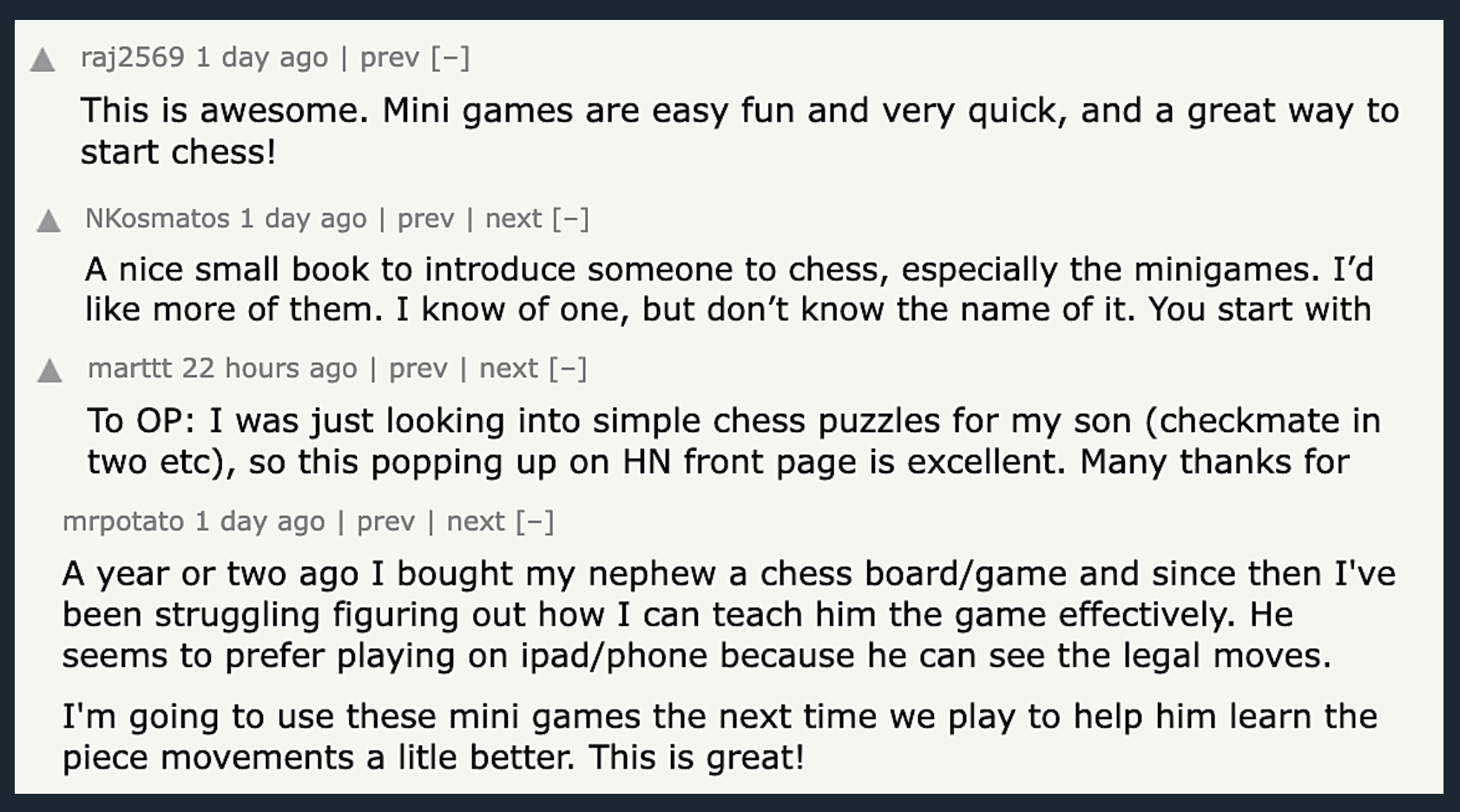
For me, the more important part of writing my chess books was marketing the work to a public forum and getting a positive reception. This proved that the books did what I hoped they would do. Without concrete actual feedback from strangers, how would I know that I wrote a decent book?

In a previous life, I worked at a company called ReadMe whose product was all about documentation. I managed dozens of enterprise customer accounts end-to-end, from defining goals to setting up their documentation hubs and troubleshooting, to closing the loops on feedback, contract renewals, everything.
I had to teach a lot of different people (in different countries) how to teach their audiences, customers, constituencies. I enjoy walking through how to think systematically about any given problem, and where the product I'm selling you can or cannot make your problem profitable to solve for you.
I may not code much or well, but communication is my lever of maximum impact and the thing I've spent the majority of my career on, starting from Lean On Me in college building specialized mental health trainings (e.g. suicide prevention hotlines staffed by college kiddos).
In its most general form, I guess I would say my primary professional experience has been helping people think about thinking about relationships. Both in explicit business contexts as well as more casually and personally, because that matters too, even if we're "just doing business".
In my new role at Simple, I'm excited to bring all my life experience to bear on the joyous opportunities AI brings to make things easy & smooth for all humans around the world, starting with synchronous voice!
I see the future as bright and shining and calling to us all. The only requirement is that I look at it from the right angle.